Reflections on the Daily Readings 9th August 2021
Webmaster • August 7, 2021

Monday 9th August


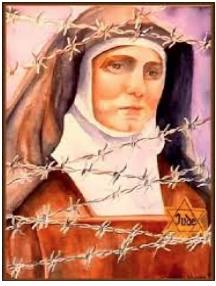
Memorial Of Teresa Benedicta Of The Cross,

Pick up a page-turner of faith


Saint Teresa Benedicta of the Cross was born Edith Stein in 1891 and was killed at Auschwitz in 1942. She was a German Jewish philosopher who had been an atheist, although she had admired Christians she knew. She shocked everyone by becoming Catholic and, 11 years later, a Carmelite nun. Her conversion was prompted by an all-night reading of the autobiography of Saint Teresa of Ávila, a 16th-century Carmelite also of Jewish origins. Pick up a copy of the autobiographies of both these riveting saints—and see how they contribute to your own ongoing conversion.


Today's readings: Deuteronomy 10:12-22; Matthew 17:22-27 (413).

“And they were overwhelmed with grief.”


Tuesday 10th August


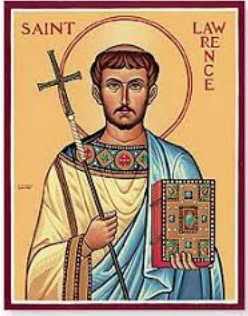
Feast Of Lawrence,

Find your way to serve


Lawrence was one of seven deacons martyred in Rome under Emperor Valerian in 258. The word deacon—from the Greek word for service— describes the work of these early ministers: beginning with the first seven deacons mentioned in the Acts of the Apostles, appointed to serve the everyday needs of the flock while the apostles busied themselves with evangelization. Today’s Catholic deacons are ordained; permanent deacons can preach at Mass and preside over weddings, Baptisms, and funerals—while transitional deacons later become priests.


Today's readings: 2 Corinthians 9:6-10; John 12:24-26 (618).

"Where I am, there also will my servant be."


Wednesday 11th August


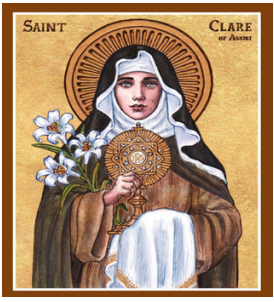
Memorial Of Clare,

Hope lights the way


Saint Clare, founder of the Poor Clare order of nuns, is part of a long line of women and men who gave up everything for the sake of following Christ, and, in turn, inspired others to join them on their holy journey. Often meeting significant resistance, these brave souls persevered, driven by a passion to bring God’s Good News to the world. “Like a shooting star against the dark sky of injustice and ignorance, founders of religious communities lit up the landscape with a burst of hope,” says Precious Blood Father Joe Nassal. Saint Gaspar, the founder of the Missionaries of the Precious Blood, like Saint Clare hoped to free people from the chains of societal conformity. Clare chose to do it within the confines of a cloister; Gaspar, as an itinerant preacher. Both were being true to themselves and the gospel. Follow your own path toward hope.


Today's readings: Deuteronomy 34:1-12; Matthew 18:15-20 (415).

“His eyes were undimmed and his vigor unabated.”

Thursday 12th August


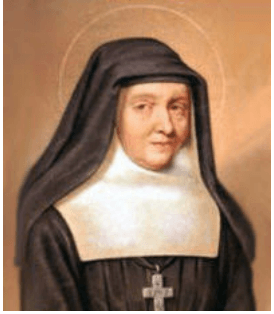
Memorial Of Jane Frances De Chantal,

Love lifted her higher


Jane Frances de Chantal, a French widow who founded the Visitation Nuns in 1610, was a well-off, educated woman with administrative talent and deep faith who was widowed at age 28. Obliged to live with a cruel father-in-law, she coped by pouring herself into charity work and spiritual development, eventually teaming up with Saint Francis de Sales to found a religious community. Have you ever coped with difficulties by trying to become a better person? What trial in your life could nudge you toward greater goodness?


Today's readings: Joshua 3:7-10a, 11, 13-17; Matthew 18:21—19:1 (416).

“Moved with compassion the master of that servant let him go and forgave him the loan.”

Friday 13th August


Memorial Of Pontian, Pope, And Hippolytus,

What unites is greater than what divides


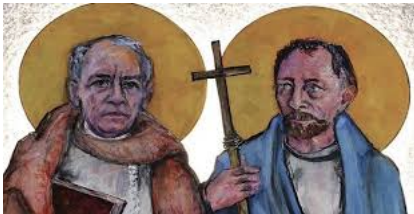
Pope Pontian and Hippolytus were both imprisoned in Sardinia during Roman persecutions. Before their deaths in 235, Pontian and Hippolytus reconciled, because for a time the two were archenemies. Indeed, Hippolytus had been elected antipope by his followers who were in stark opposition to Pontian’s tolerant stance on reconciling returning Christians to the church. In the end, Pontian and Hippolytus realized that their shared love of Christ far surpassed any differences. Finding one common element with an enemy is the first step toward reconciliation. Perhaps we can start with our shared humanity and work our way from there.


Today's readings: Joshua 24:1-13; Matthew 19:3-12 (417).

“I gave you a land that you had not tilled and cities that you had not built, to dwell in.”


Saturday 14th August


Memorial Of Maximilian Kolbe,

Give a piece of your heart


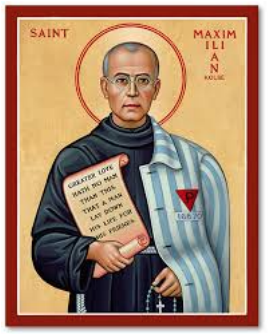
Maximilian Kolbe shook up the rules for saint-making. At Kolbe’s 1982 canonization, Pope John Paul II named him a “martyr of charity.” No longer could one become a martyr only by being killed because of “hatred for the faith.” Now one killed because of charitable work, as Maximilian was, could also be a martyr. This opened the door to sainthood for others who were murdered for their good work, like Notre Dame Sister Dorothy Stang of Brazil, the Adorers of the Blood of Christ sisters of Liberia, or the Maryknoll sisters of El Salvador. We are all called in some way to be martyrs, even if we give away only a part of our lives. Give away a piece of your life today.


Today's readings: Joshua 24:14-29; Matthew 19:13-15 (418).

“Let the children come to me, and do not prevent them; for the Kingdom of heaven belongs to such as these.”

By Webmaster August 8, 2026
First Reading 1 Kings 19:9a,11-13a The Lord appears to Elijah in a whisper. Responsorial Psalm Psalm 85:9-14 The Lord is the source of salvation. Second Reading Romans 9:1-5 Paul speaks of the blessings that have come to the Israelites. Gospel Reading Matthew 14:22-33 Jesus walks on water, and the disciples acknowledge him as the Son of God.  Background on the Gospel Reading Today’s Gospel directly follows last week’s account of Jesus feeding a crowd of more than 5,000 people with just five loaves of bread and two fish. For the sake of the crowds, Jesus had postponed his time of solitude. Now, at last, Jesus finds some time for quiet and prayer. He sends his disciples ahead of him by boat, dismisses the crowds, and then withdraws to the mountain to pray. The disciples do not fare well. They struggle to weather the wind and waves, making little progress in their journey. We are reminded of a previous story in Chapter 8 of Matthew’s Gospel, when Jesus calms the seas. This time, however, Jesus does not calm the seas, and the disciples do not express fear until they see Jesus walking toward them on the water. In this story it is not the storm that is feared but the sight of Jesus before them, whom they mistake for a ghost. Clues like these suggest that this story is about the disciples’ growing understanding of the identity of Jesus. In continuity with last week’s Gospel about the feeding of the multitude, today’s Gospel is also about what the disciples’ faith in Jesus will enable them to do. In last week’s Gospel, when the disciples see the crowds, they ask Jesus to send the crowds away. Jesus turns the situation around, telling the disciples to feed the crowd with the provisions that they have. Both of these Gospels tell us much about ministry. Jesus calls to the disciples and calms their fears. He is not a ghost. The impulsive Peter seeks proof that the person is indeed Jesus. He asks Jesus to call him out onto the water, and Jesus grants this request. Peter’s fear and doubt overtake him, however, once he is walking on the water. Jesus reaches out to Peter and saves him. When Jesus and Peter enter the boat, Matthew reports that the wind ceases, and the disciples confess that Jesus is the Son of God. Faith in Jesus will enable the disciples to do the work that Jesus has done. Peter walks on water. The five loaves and two fish feed a multitude of people. The disciples can and will participate in the work of the kingdom of heaven. When Peter fears and doubts the person of Jesus, however, he falters. Peter’s example teaches us that true Christian ministry emerges from the faith that Jesus is the Messiah, God’s only Son.
By Webmaster August 1, 2026
First Reading Isaiah 55:1-3 The Lord will renew his covenant with the descendents of David. Responsorial Psalm Psalm 145:8-9,15-18 The Lord provides for his people. Second Reading Romans 8:35,37-39 Nothing can separate us from the love of God. Gospel Reading Matthew 14:13-21 Jesus feeds the crowd with five loaves and two fish. Background on the Gospel Reading Today we jump ahead in our reading of Matthew's Gospel to Chapter 14. Last week we heard Jesus conclude his discourse with the crowds about the Kingdom of Heaven. In Matthew's narrative, Jesus then leaves the crowds and returns to Nazareth, where he is rejected. Matthew then recounts the story of John the Baptist's arrest and execution at the hands of Herod. Today's Gospel reading begins at this point. Upon hearing the news of the death of John the Baptist, Jesus seeks to withdraw, but the crowds follow him. Jesus reaches out to them in compassion and heals the sick. At the end of a long day, the disciples encourage Jesus to send the crowds away so that they might find provisions for themselves. Jesus again responds with compassion for the crowd. Jesus tells his disciples to provide food for the crowd. The disciples reply with a report of the meagerness of their own provisions—five loaves and two fish. The result is the very familiar miracle of the multiplication of the loaves and fish. Matthew's Gospel tells us that 5,000 men were fed, and this number does not even include the women and children. Jesus' blessing brought abundance from the meager provisions of the disciples. In this action, Jesus offers us a sign of the Kingdom of Heaven that he has been teaching about in the parables. A feast results from the smallest of portions—remember the mustard seed and the yeast. In this miracle we witness an example for Christian life and ministry. Even the smallest of offerings can produce abundant results when placed in the service of the Kingdom of Heaven. We find the story of Jesus' multiplication of the loaves and the fish in each of the four Gospels. In the Gospels of Mark and Matthew, Jesus performs this same miracle on two separate occasions. The story of this miracle is an anticipation of the Eucharist in which we are fed by the abundant grace of God. The importance of the Eucharist has been a defining element of Christian life from the very beginning.
By Webmaster July 17, 2026
Please pray for Our Sick : Margaret Callaghan Doreen Cleary, Neil Boyle, John Rielly Molly Strang, James Clark, Fr. Michael McLaughlin, Patricia Henderson, Joanna Maier (Connecticut USA), Therese Gilgunn Tressy Callaghan, Suzanne McMurray, Mary Coyle, Lesley Watson (Spain) Maureen McHugh, Margaret Burke, Marie White, Kathleen Daly, John McGuire, Jill Brown, Karen Pritchatt, Louise Newton, Faith Lyndsey, Jill Brown, Marie McGuire, James Morton, Paul Kearney, Thomas Daly, Andrew McCluskey, Premature Baby Vincent McDowell, Bill Allan, Gudren Berk (Germany), Jaqueline McReynolds, Mary Morrison, Helen Howarth (Easterhouse), Margaret Loan, Avril McCluskey, Carol Corr, Thomas Kennedy, David Borland, Margaret Park, and all our sick. .
By Webmaster July 17, 2026
Just to let you know I am going on holiday on Tuesday. I will be back on Saturday 8th August for the 10am Mass. The Holy Ghost Fathers are looking after the parish from Tuesday 21st to 27th and Fr. Brown will take over from 28th to 7th August. The next Bulletin will be Thursday 13th August.
By Webmaster July 17, 2026
First Reading 1 Kings 3:5,7-12 Solomon pleases God when he asks for a wise and understanding heart to better govern the people. Responsorial Psalm Psalm 119:57,72,76-77,127-130 The law of the Lord is more precious than silver and gold. Second Reading Romans 8:28-30 God chose us to be conformed to the image of his Son. Gospel Reading Matthew 13:44-52 (shorter form: Matthew 13:44-46) Jesus teaches about the Kingdom of Heaven.  Background on the Gospel Reading Today’s Gospel concludes three weeks of readings from the 13th Chapter of Matthew’s Gospel. Throughout these three weeks we have heard Jesus teaching crowds about the kingdom of heaven, and we have heard Jesus interpret some of his teachings for the disciples. In this week’s Gospel, Jesus offers three more short parables. The first two parables describe the great value of the kingdom of heaven. In the first parable, Jesus says that the kingdom of heaven is like a buried treasure that is worth possessing even if it means giving up everything else. In the second parable, Jesus proposes that the kingdom of heaven is like a pearl of great worth for which one will sell everything else to possess. These parables teach us that we are to place everything we value in the service of the pursuit of the Kingdom of God. The third parable that Jesus proposes in today’s Gospel is different from the first two, but it is reminiscent of the parable of the sower heard in last week’s Gospel. The kingdom of heaven is compared to fishing with a wide net. After the fish have been collected, the good fish are kept and the bad fish are thrown away; so too, in the final judgment, will the wicked and the righteous be separated. Today’s Gospel concludes with a curious statement about the scribe who understands the kingdom of heaven. Here a metaphor is offered: this scribe is like the head of a household who “brings from his storeroom both the new and the old.” The scribes referred to here are experts of Mosaic law. It is possible that Jesus is here instructing the early Christian community on how to proceed in the interpretation of Jewish law with respect to Jesus’ “new” teaching. Jesus’ teaching about the kingdom of heaven does not replace the Jewish tradition; it interprets it in a different light.
By Webmaster July 17, 2026
First Reading Wisdom 12:13,16-19 God has shown himself to be a God of justice and mercy. Responsorial Psalm Psalm 86:5-6,9-10,15-16 A prayer to God for mercy. Second Reading Romans 8:26-27 The Spirit intercedes for us with God. Gospel Reading Matthew 13:24-43 (shorter form: Matthew 13:24-30) Jesus offers parables about the Kingdom of Heaven and explains them to his disciples.  Background on the Gospel Reading In today’s Gospel, Jesus offers three parables to describe the Kingdom of Heaven. He also explains why he speaks to the crowds in parables and interprets the parable of the sower for the disciples. This reading is a continuation of Jesus’ discourse that we began reading last Sunday. All three parables use commonplace experiences to describe aspects of the Kingdom of Heaven. The first parable is longer and more detailed than the next two, and it alerts us to the two-fold reality of the Kingdom of Heaven. The beginnings of the Kingdom of Heaven can be found in this world. The fruition of the Kingdom of Heaven, however, will not be realized until the final judgment. In the meantime, as Jesus’ explanation to the disciples cautions, any effort to judge the progress of the Kingdom of Heaven is premature. Only God, in the final judgment, will distinguish the fruit of the Kingdom of Heaven and offer its reward. The second and third parables call to our attention the abundance that will result from the small beginnings of the Kingdom of Heaven. Just as a mustard seed—the smallest of all seeds—will become a large bush, so too God will bring his Kingdom to full bloom. As a small amount of yeast will leaven the entire batch of bread, so too God will bring about the expansion of his Kingdom. In each case the image is of the superabundance that God brings out of even the smallest of signs of the Kingdom. Contained within these parables are words of caution as well as words of consolation. In the parable of the sower we are warned against judging others. To judge and uproot the “weeds” prematurely will harm the wheat; final judgment rests with God. In the parables of the mustard seed and the yeast, we are consoled by the message that God can work wonders and produce abundance from even the smallest beginnings of the Kingdom of Heaven.
By Webmaster July 17, 2026
Our Recently Dead Ruth Leabody, Mary Coyle, Bobby Frew, Jim Kennedy (Strathaven), John McKenzie Month Minds & Anniversaries Ann & Hugh Rodgers, Pat Dougan, John Smith, William Smith, Peter McGarry, Raymond Findlater Please if you could make sure all month minds and anniversaries are handed in no later than Wednesday Night. If they come in after that they will be read out at Mass on Sunday. If the recently dead come in after the Wednesday deadline they too will be read out at Mass on the Sunday
By Webmaster July 11, 2026
If you wish to sign up for Gift Aid. It is a great way to help the parish financially, costing you absolutely nothing. If you wish to sign up contact myself or Doreen Lee and we will give you the form and hand it back as you can and we can get it organised. As I said it costs you nothing, but helps the parish so much.
By Webmaster July 11, 2026
First Reading Isaiah 55:10-11 The Word of the Lord shall achieve its purpose. Responsorial Psalm Psalm 65:10-14 A prayer of praise to God for his abundance. Second Reading Romans 8:18-23 Together with all of creation, we await God’s redemption. Gospel Reading Matthew 13:1-23 (shorter form: Matthew 13:1-9) Jesus teaches that the kingdom of heaven is like seed that has been sown on good soil.  Background on the Gospel Reading Today’s Gospel marks the beginning of the third long discourse given by Jesus in the Gospel of Matthew. Over the next few weeks, the Gospel readings will consist of the entire 13th Chapter of Matthew’s Gospel, a lengthy teaching discourse. Throughout this discourse, Jesus will offer several parables to illustrate for his listeners what he means by the kingdom of heaven. He begins with the parable of the sower, which appears rather straightforward—of course seeds grow best in good soil. Seeds that miss the soil, are sown on rocky ground, or are sown among other plants will not grow. The surprise in the parable is the enormous yield of the seed that is sown on good soil. Jesus then explains his use of parables. Jesus seems to suggest that he uses parables to teach because the meanings of parables are not self-evident. The hearer must engage in some degree of reflection in order to comprehend the message of a parable. In this way, the medium—the parable—models the point of the parable of the sower. Those who are willing to engage themselves in the effort to understand will be rewarded by the discovery of the message and will bear fruit. To bring home the point, Jesus interprets the parable of the sower to his disciples. The different types of soil in which the seeds are sown are metaphors for the disposition with which each individual hears the teaching about the kingdom of heaven. Some will be easily swayed away from the kingdom of heaven. Some will receive it for a time but will lose it when faced with difficulties. Some will hear the word but will then permit other cares to choke it out. Yet some will receive it well, and the seed will produce abundant fruit.
By Webmaster July 11, 2026
I am also looking for Volunteers to move the power-points on during the Sunday Masses, Vigil 4pm, 9.30am & 11am. It is very easy to operate, if we get enough volunteers for each Mass we would put a wee rota together. It would take a wee bit of pressure off me.
Show More