Reflections on the Daily Readings 6th September 2021

Webmaster • September 4, 2021

Monday 6th September


Labour of love


As we enjoy food at picnics and barbecues, let’s remember who harvested this food—many of them Spanish-speaking migrant workers, many of them fellow Catholics. Consider what your parish can do for migrant workers in your area. Perhaps a clothing drive or a fundraiser to buy rosaries and Bibles in Spanish or other languages of a migrant group. Or enlist school kids to write translated notes of welcome and thanks for the hard work migrants do. Catholic Charities helped nearly 400,000 migrants, immigrants, and refugees this past year with all kinds of assistance—learn more about their work and how you can pitch in.


Today's readings: Colossians 1:24—2:3; Luke 6:6-11

“Is it lawful to do good on the sabbath rather than to do evil, to save life rather than to destroy it?”


Tuesday 7th September


Creation needs your caring prayer


Jewish believers celebrate Rosh Hashanah today, marking the birthday of the universe—recalling how God placed Adam and Eve at the center of creation as faithful stewards. For many Christians, it’s also Day 7 in the Season of Creation. When the Catholic Church joined this observance in 2019, Pope Francis wrote: “In the silence of prayer, we can hear the symphony of creation calling us to abandon our self-centeredness in order to feel embraced by the tender love of the Father and to share with joy the gifts we have received.” Pray to become a more selfless steward of creation.


Today's readings: Colossians 2:6-15; Luke 6:12-19

“Jesus departed to the mountain to pray.”

Wednesday 8th September


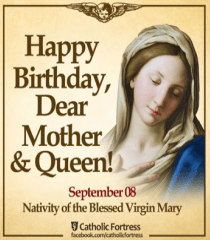
Feast Of The Nativity Of The Blessed Virgin Mary

The birth of our salvation


In 431, bishops at the Council of Ephesus decreed Mary as Theotokos, a Greek word that means “God-bearer”—or, more commonly, “Mother of God.” Her birthday was celebrated at the beginning of the year—in Constantinople, the calendar began on September 1—because Mary’s birth is also the beginning of our salvation, through her son. “Be of good cheer,” wrote Saint Andrew of Crete, “this is the Feast of the Nativity of the Virgin and of the renewal of the human race!” Honor Mary today by praying the Magnificat, also known as the “Ode of the Theotokos.”


Today's readings: Micah 5:1-4a or Romans 8:28-30; Matthew 1:1-16, 18-23 (636).

“From you shall come forth for me one who is to be ruler in Israel, whose origin is from of old.”
Thursday 9th September


Memorial Of Peter Claver, Priest

Call it out


Saint Peter Claver (1580-1654) was a Jesuit priest dedicated to baptizing and serving enslaved Africans in Cartagena, Colombia, a major slavetrade port. While Claver was ahead of many of his peers in at least recognizing the humanity of Africans and poured out his life to alleviate the great suffering he encountered, we need to acknowledge that the colonial system that enslaved Africans was allowed to continue unabated for centuries without much church resistance. How can we and our communities of faith challenge the enduring legacy of racism today, inspired by Claver’s witness of service and the gospel mandate to love?


Today's readings: Colossians 3:12-17; Luke 6:27-38 (440).

“Do to others as you would have them do to you.”


Friday 10th September


Because of you . . .


A 2014 study found that “young people with mentors, especially at-risk youth, have more positive visions of themselves and their futures, and they also achieve more positive outcomes in school, the workplace, and their communities.” The value of mentoring is nothing new. Proverbs 22:6 says: “Train the young in the way they should go; even when old, they will not swerve from it.” Whether you are teaching a practical or spiritual skill or a new technique or way of thinking, your instruction will have an impact. Take time to be a good mentor for the sake of the next generation and the greater glory of God.


Today's readings: 1 Timothy 1:1-2, 12-14; Luke 6:39-42 (441).

“When fully trained, every disciple will be like his teacher.”


Saturday 11th September


Heaven help us all


The attack on the World Trade Center and the Pentagon happened 20 years ago today. We still carry the memory of that awful day, and we continue to remember in our prayers the victims of the attack and their families and loved ones who continue to mourn their great loss. We remember the passengers and crew of the aircraft destroyed in the attack as well as the victims on the ground. We remember especially the brave first responders who ran toward danger rather than away, many of whom gave away their health and lives to save others. And we pray for the terrorists as well, because we believe in the redemptive power of prayer and because hatred and vengeance have no place in our hearts. May all of humanity be redeemed.


Today's readings: 1 Timothy 1:15-17; Luke 6:43-49 (442).

“A good person out of the store of goodness in his heart produces good


By Webmaster • November 6, 2026
Please pray for Our Sick : Margaret Callaghan Doreen Cleary, Neil Boyle, John Rielly, James Clark, Fr. Michael McLaughlin, Patricia Henderson, Joanna Maier (Connecticut USA), Therese Gilgunn Tressy Callaghan, Suzanne McMurray, Marie White,Lesley Watson (Spain) John McGuire, Jill Brown, Maureen McHugh,Margaret Burke, Paul Kearney,Kathleen Daly, Karen Pritchatt, Louise Newton, Faith Lyndsey, Marie McGuire, James Morton, Thomas Daly, Andrew McCluskey, Margaret Loan, Premature Baby Vincent McDowell, Gudren Berk (Germany), Jaqueline McReynolds, Mary Morrison, Helen Howarth (Easterhouse), Avril McCluskey, Carol Corr, Margaret Park, Thomas Kennedy, Alana Hepburn, Michael Ritchie, Hugh O'Donnell, Mary Brandon, Michelle McDade, Pope Leo, Baby Matteo, Angela Hendry, Patsy McMenemy, James McLernon (Blantyre) and all our sick. .
By Webmaster • November 6, 2026
Saint Martin of Tours’ Story A conscientious objector who wanted to be a monk; a monk who was maneuvered into being a bishop; a bishop who fought paganism as well as pleaded for mercy to heretics—such was Martin of Tours, one of the most popular of saints and one of the first not to be a martyr. Born of pagan parents in what is now Hungary, and raised in Italy, this son of a veteran was forced at the age of 15 to serve in the army. Martin became a Christian catechumen and was baptised when he was 18. It was said that he lived more like a monk than a soldier. At 23, Martin of Tours refused a war bonus and told his commander: “I have served you as a soldier; now let me serve Christ. Give the bounty to those who are going to fight. But I am a soldier of Christ and it is not lawful for me to fight.” After great difficulties, he was discharged and went to be a disciple of Hilary of Poitiers. He was ordained an exorcist and worked with great zeal against the Arians. Martin became a monk, living first at Milan and later on a small island. When Hilary was restored to his see following his exile, Martin returned to France and established what may have been the first French monastery near Poitiers. He lived there for 10 years, forming his disciples and preaching throughout the countryside. The people of Tours demanded that he become their bishop. Martin was drawn to that city by a ruse—the need of a sick person—and was brought to the church, where he reluctantly allowed himself to be consecrated bishop. Some of the consecrating bishops thought his rumpled appearance and unkempt hair indicated that he was not dignified enough for the office. Along with Saint Ambrose, Martin rejected Bishop Ithacius’s principle of putting heretics to death—as well as the intrusion of the emperor into such matters. He prevailed upon the emperor to spare the life of the heretic Priscillian. For his efforts, Martin was accused of the same heresy, and Priscillian was executed after all. Martin then pleaded for a cessation of the persecution of Priscillian’s followers in Spain. He still felt he could cooperate with Ithacius in other areas, but afterwards his conscience troubled him about this decision. As death approached, Martin’s followers begged him not to leave them. He prayed, “Lord, if your people still need me, I do not refuse the work. Your will be done.”Reflection Martin’s worry about cooperation with evil reminds us that almost nothing is either all black or all white. The saints are not creatures of another world: They face the same perplexing decisions that we do. Any decision of conscience always involves some risk. If we choose to go north, we may never know what would have happened had we gone east, west, or south. A hyper-cautious withdrawal from all perplexing situations is not the virtue of prudence; it is in fact, a bad decision, for “not to decide is to decide.” Let us pray that we are able to journey this life of ours with the same passion and zeal as Martin of Tours. And let us hope that our efforts, however brave or futile, can convert hearts to God’s overflowing grace. Saint Martin: Pray for us! Saint Martin of Tours is a Patron Saint of: Horses, Soldiers & South Africa
By Webmaster • November 6, 2026
First Reading Wisdom 6:12-16 Wisdom will come to those who seek it. Responsorial Psalm Psalm 63:2,3-4,5-6,7-8 Our souls are thirsting for God. Second Reading 1 Thessalonians 4:13-18 (shorter form: 1 Thessalonians 4:13-14) God will raise all those who have died. Gospel Reading Matthew 25:1-13 Jesus tells the parable of the wise and foolish virgins, teaching his disciples the importance of being prepared to receive the Kingdom of Heaven Background on the Gospel Reading In this week’s Gospel, Jesus talks about what it means to be prepared to receive the Kingdom of Heaven. This week’s reading follows a series of warnings and predictions by Jesus about the coming of the Son of Man. Jesus wants his disciples to understand that the exact day and time cannot be predicted. He teaches the disciples that they must remain vigilant so that they will not be caught unprepared. When thinking about the parable of the wise and foolish virgins, it is important to consider the first-century wedding traditions of Palestine. Scholars tell us that it was the custom of the day for young maidens—friends and family members of the bride—to meet the bridegroom when he came to bring his bride to her new home.  As with many of Jesus’ parables, several levels of interpretation are possible. In last week’s Gospel, we heard Jesus warn against following the example of the Pharisees and scribes. If read in the context of early Christianity’s struggle to define itself against Pharisaic Judaism, this parable is a continuing critique of Judaism. It suggests that the Jewish leaders were like the foolish virgins, unprepared to meet Jesus, the bridegroom of Israel. In the chapter preceding this parable, however, Jesus warns about the destruction of Jerusalem, the tribulation of the end times, and the coming of the Son of Man. When read in this context, today’s parable is a warning to the Christian community to remain vigilant and prepared to receive Jesus, the Son of Man who will return at the end of time. This interpretation is supported by the reference to the delay of the bridegroom. The Christian community for whom Matthew wrote this Gospel was coming to terms with the realization that the promise of Jesus’ return would not be fulfilled within their lifetimes. The question remains for us to ask ourselves, Are we ready to receive Jesus? Will we be prepared to receive him?
By Webmaster • November 6, 2026
Coffee Morning Every Tuesday. Next one 10th November
By Webmaster • November 6, 2026
This Saturday the 7th November is our Annual Mass for the Dead. Invitations have been sent out to the families of those who lost a loved one in the last year. However, the Mass is open to anyone who wants to come and pray for their loved and to remember them by lighting a candle for them.
By Webmaster • November 6, 2026
Our Recently Dead Robert Gallacher, Theresa Cahill, Jean Dougan, Tom "Tosh" Gaffney Month Minds & Anniversaries John Corns, John Drummond, Matthew Fox, Johnny Lyons, John Jamieson, Kenny Lee, Jon Smith, Ada Quinn  Please if you could make sure all month minds and anniversaries are handed in no later than Wednesday Night. If they come in after that they will be read out at Mass on Sunday. If the recently dead come in after the Wednesday deadline they too will be read out at Mass on the Sunday
By Webmaster • October 30, 2026
Will be available in the porch from this weekend. Mass will be offered each day in November for those names included on the list. You may include an offering alongside the list in your envelope.  And from Tuesday there will be a box in the porch to return them.
By Webmaster • October 30, 2026
Panto 2027 January 8th 2027 Goldilocks  Price £36 including Bus Sign up Sheet in Porch Scan the QR code on the notice board in the Church Click on the following link as well. St Peters Panto Trip Jan 2027 – Fill in form
By Webmaster • October 30, 2026
Saint Charles Borromeo’s Story The name of Charles Borromeo is associated with reform. He lived during the time of the Protestant Reformation, and had a hand in the reform of the whole Church during the final years of the Council of Trent. Although he belonged to the Milanese nobility and was related to the powerful Medici family, Charles Borromeo desired to devote himself to the Church. In 1559, when his uncle, Cardinal de Medici was elected Pope Pius IV, he made Charles cardinal-deacon and administrator of the Archdiocese of Milan. At the time Charles was still a layman and a young student. Because of his intellectual qualities Charles was entrusted with several important offices connected with the Vatican, and later appointed secretary of state with responsibility for the papal states. The untimely death of his elder brother brought Charles to a definite decision to be ordained a priest, despite his relatives’ insistence that he marry. Soon after being ordained a priest at age 25, Borromeo was consecrated bishop of Milan. Working behind the scenes, Saint Charles deserves the credit for keeping the Council of Trent in session when at several points it was on the verge of breaking up. Borromeo encouraged the pope to renew the Council in 1562, after it had been suspended for 10 years. He took upon himself the task of the entire correspondence during the final phase. Because of his work at the Council, Borromeo was unable to take up residence in Milan until the Council concluded. Eventually, Borromeo was allowed to devote his time to the Archdiocese of Milan, where the religious and moral picture was far from bright. The reform needed in every phase of Catholic life among both clergy and laity was initiated at a provincial council of all the bishops under him. Specific regulations were drawn up for bishops and other clergy: If the people were to be converted to a better life, Borromeo had to be the first to give a good example and renew their apostolic spirit. Charles Borromeo took the initiative in giving a good example. He allotted most of his income to charity, forbade himself all luxury, and imposed severe penances upon himself. He sacrificed wealth, high honors, esteem, and influence to become poor. During the plague and famine of 1576, Borromeo tried to feed 60,000 to 70,000 people daily. To do this he borrowed large sums of money that required years to repay. Whereas the civil authorities fled at the height of the plague, he stayed in the city, where he ministered to the sick and the dying, helping those in want. Work and the heavy burdens of his high office began to affect Archbishop Borromeo’s health, leading to his death at the age of 46. Reflection Saint Charles Borromeo made his own the words of Christ: “…I was hungry and you gave me food, I was thirsty and you gave me drink, a stranger and you welcomed me, naked and you clothed me, ill and you cared for me, in prison and you visited me” (Matthew 25:35-36). Borromeo saw Christ in his neighbour, and knew that charity done for the least of his flock was charity done for Christ.  Saint Charles Borromeo is a Patron Saint of:Catechists, Catechumens & Seminarians
By Webmaster • October 30, 2026
First Reading Revelation 7:2-4,9-14 John describes his vision: those who have endured the trials worship the Lamb. Responsorial Psalm Psalm 24:1-2,3-4,5-6 Those who seek the face of the Lord shall be rewarded. Second Reading 1 John 3:1-3 We are God's children now. Gospel Reading Matthew 5:1-12 Jesus teaches what it means to be happy. Background on the Gospel Reading Every year the Church recalls the example, witness, and prayer of the holy women and men who have been identified by the Church as Saints. These saints are more than just role models; they are family members with whom we continue to share relation, in a bond of prayer, called the Communion of Saints. Every year when we celebrate this day, the Gospel we proclaim recalls for us Jesus' teaching about happiness, the Beatitudes. We quickly note in this reading that none of those Jesus names as “blessed” or “happy” are expected . . . the poor in spirit, the meek, the persecuted. Jesus' blueprint for happiness reflects little of what the world might call happiness.  What does Jesus mean when he uses the word “blessed?” This word is sometimes translated as “happy” or “fortunate” or “favored.” In other words, Jesus is saying that divine favor is upon those who are poor, who mourn, who are persecuted. This might have been welcome and surprising news to the crowds who heard Jesus that day. The Beatitudes can be understood as a framework for Christian living. Because of this, it is natural that we proclaim this Gospel on the Feast of All Saints. Saints are people who lived the spirit of the Beatitudes as Jesus lived. On this day, we too are challenged to model our lives on the spirit and promises of the Beatitudes.
Show More