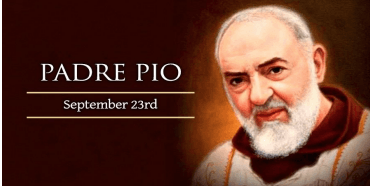
Saint Pio of Pietrelcina’s Story

Webmaster • September 18, 2021

In one of the largest such ceremonies in history, Pope John Paul II canonized Padre Pio of Pietrelcina on June 16, 2002. It was the 45th canonization ceremony in Pope John Paul’s pontificate. More than 300,000 people braved blistering heat as they filled St. Peter’s Square and nearby streets. They heard the Holy Father praise the new saint for his prayer and charity. “This is the most concrete synthesis of Padre Pio’s teaching,” said the pope. He also stressed Padre Pio’s witness to the power of suffering. If accepted with love, the Holy Father stressed, such suffering can lead to “a privileged path of sanctity.”

Many people have turned to the Italian Capuchin Franciscan to intercede with God on their behalf; among them was the future Pope John Paul II. In 1962, when he was still an archbishop in Poland, he wrote to Padre Pio and asked him to pray for a Polish woman with throat cancer. Within two weeks, she had been cured of her life threatening disease.

Born Francesco Forgione, Padre Pio grew up in a family of farmers in southern Italy. Twice his father worked in Jamaica, New York, to provide the family income.

At the age of 15, Francesco joined the Capuchins and took the name of Pio. He was ordained in 1910 and was drafted during World War I. After he was discovered to have tuberculosis, he was discharged. In 1917, he was assigned to the friary in San Giovanni Rotondo, 75 miles from the city of Bari on the Adriatic.

On September 20, 1918, as he was making his thanksgiving after Mass, Padre Pio had a vision of Jesus. When the vision ended, he had the stigmata in his hands, feet, and side.

Life became more complicated after that. Medical doctors, Church authorities, and curiosity seekers came to see Padre Pio. In 1924, and again in 1931, the authenticity of the stigmata was questioned; Padre Pio was not permitted to celebrate Mass publicly or to hear confessions. He did not complain of these decisions, which were soon reversed. However, he wrote no letters after 1924. His only other writing, a pamphlet on the agony of Jesus, was done before 1924.

Padre Pio rarely left the friary after he received the stigmata, but busloads of people soon began coming to see him. Each morning after a 5 a.m. Mass in a crowded church, he heard confessions until noon. He took a mid-morning break to bless the sick and all who came to see him. Every afternoon he also heard confessions. In time his confessional ministry would take 10 hours a day; penitents had to take a number so that the situation could be handled. Many of them have said that Padre Pio knew details of their lives that they had never mentioned.

Padre Pio saw Jesus in all the sick and suffering. At his urging, a fine hospital was built on nearby Mount Gargano. The idea arose in 1940; a committee began to collect money. Ground was broken in 1946. Building the hospital was a technical wonder because of the difficulty of getting water there and of hauling up the building supplies. This “House for the Alleviation of Suffering” has 350 beds.

A number of people have reported cures they believe were received through the intercession of Padre Pio. Those who assisted at his Masses came away edified; several curiosity seekers were deeply moved. Like Saint Francis, Padre Pio sometimes had his habit torn or cut by souvenir hunters.

One of Padre Pio’s sufferings was that unscrupulous people several times circulated prophecies that they claimed originated from him. He never made prophecies about world events and never gave an opinion on matters that he felt belonged to Church authorities to decide. He died on September 23, 1968, and was beatified in 1999.


Reflection

Referring to that day's Gospel (Matthew 11:25-30) at Padre Pio’s canonization Mass in 2002, Saint John Paul II said: “The Gospel image of ‘yoke’ evokes the many trials that the humble Capuchin of San Giovanni Rotondo endured. Today we contemplate in him how sweet is the ‘yoke’ of Christ and indeed how light the burdens are whenever someone carries these with faithful love. The life and mission of Padre Pio testify that difficulties and sorrows, if accepted with love, transform themselves into a privileged journey of holiness, which opens the person toward a greater good, known only to the Lord.”

By Webmaster January 30, 2026
Please pray for Our Sick : Margaret Callaghan Doreen Cleary, Michael Ritchie, Neil Boyle, John Rielly Molly Strang, James Clark, Fr. Michael McLaughlin, Patricia Henderson, Joanna Maier (Connecticut USA), Therese Gilgunn Tressy Callaghan, Suzanne McMurray, Mary Coyle, Lesley Watson (Spain) Maureen McHugh, Margaret Burke, Marie White, Kathleen Daly, John McGuire, Jill Brown, Karen Pritchatt, Louise Newton, Faith Lyndsey, Jill Brown, Marie McGuire, James Morton, Paul Kearney, Thomas Daly, Andrew McCluskey, Premature Baby Vincent McDowell, Bill Allan, Gudren Berk (Germany), Jaqueline McReynolds, Mary Morrison, Helen Howarth (Easterhouse) Eugene McVey and all our sick.
By Webmaster January 30, 2026
Mass of the Sick Saturday 14th February 10am Mass Ash Wednesday 18th February: Masses 7am, 10am & 6pm Sacramental Meetings Tuesday 24th February St. Peter's & St. Mark's 6pm First Confession 6.30pm First Communion  7pm Confirmation Meetings will take place in the Church
By Webmaster January 30, 2026
If you wish to sign up for Gift Aid. It is a great way to help the parish financially, costing you absolutely nothing. If you wish to sign up contact myself or Doreen Lee and we will give you the form and hand it back as you can and we can get it organised. As I said it costs you nothing, but helps the parish so much.
By Webmaster January 30, 2026
First Reading Zephaniah 2:3, 3:12-13 There will be a people who remain sheltered from God’s anger. Responsorial Psalm Psalm 146:6-10 The Lord is faithful forever. Second Reading 1 Corinthians 1:26-31 God chooses the weak to show his power. Gospel Reading Matthew 5:1-12a Jesus teaches what it means to be happy. Background on the Gospel Reading Today’s reading is the beginning of Jesus’ Sermon on the Mount, which is found in Matthew’s Gospel. The form of the Beatitudes found here is not unique to Jesus. Beatitudes are found in the Old Testament, in the psalms, and in wisdom literature, for example. They are a way to teach about who will find favor with God. We quickly note in this reading that the people whom Jesus calls “blessed” and “happy” are not people we think of as blessed or happy . . . the poor in spirit, the meek, the persecuted. This Gospel is one of reversals. Jesus’ blueprint for happiness reflects little of what the world might call happiness.  “Blessed” is sometimes translated as happy, fortunate, or favored. In other words, Jesus is saying that divine favor is upon those who are poor, those who mourn, those who are persecuted. This news might have been welcome—and surprising—to the crowds who heard Jesus that day. The Beatitudes can be understood as a framework for Christian living. Our vocation as Christians is not to be first in this world, but rather to be first in the eyes of God. By referring to the good things that the faithful will experience, Matthew reminds us that those who act in the manner described in the Beatitudes will find their reward with God.
By Webmaster January 30, 2026
Our Recently Dead Frances Drummond, Mary McCrudden, Mary Mearns, Grace Hogg (Wishaw), Baby Lila Rose Kasap (2 months) Anne Marie Watson, Jean Murdoch Month Minds & Anniversaries John Corns, Margaret McCluskey, Helen Connolly, Catherine, Patrick & James O'Donnell, Mary Lyons, Margaret Mine, Marie McLaughlin, Jean & Mary Kane, Mary, Pat & Margaret Cox, Edward & Margaret Rodden Please if you could make sure all month minds and anniversaries are handed in no later than Wednesday Night. If they come in after that they will be read out at Mass on Sunday. If the recently dead come in after the Wednesday deadline they too will be read out at Mass on the Sunday
By Webmaster January 30, 2026
I am looking for Volunteers to move the power-points on during the Sunday Masses, Vigil 4pm, 9.30am & 11am. It is very easy to operate, if we get enough volunteers for each Mass we would put a wee rota together. It would take a wee bit of pressure off me.
By Webmaster January 24, 2026
The “Year of St Francis of Assisi”, was proclaimed by Pope Leo, in Rome to mark the 800th Anniversary of St Francis’ death in 2026. I am proposing to put a statue of St. Francis in the Church for this jubilee year. This is from EWTN Pope Leo XIV has proclaimed a “Special Year of St. Francis” to commemorate the 800th anniversary of the saint’s death. During this time of grace, which will extend until January 2027, the faithful are granted the opportunity to obtain a plenary indulgence . This Franciscan Jubilee Year, considered a gift for the entire Church and an occasion for authentic spiritual renewal, was inaugurated on Jan. 10 with a decree issued by the Apostolic Penitentiary of the Holy See. Until Jan. 10 of next year, the faithful can obtain this grace under the usual conditions — sacramental confession, Communion, and prayer for the intentions of the pope — by making a pilgrimage to any Franciscan conventual church or place of worship dedicated to St. Francis anywhere in the world. Furthermore, the elderly, the sick, and those who, for serious reasons, cannot leave their homes can obtain the plenary indulgence  by spiritually joining in the jubilee celebrations and offering their prayers, pains, or sufferings to God.
By Webmaster January 17, 2026
Mass of the Sick Saturday 14th February 10am Mass Ash Wednesday 18th February more details to follow.
By Webmaster January 17, 2026
The Second Sunday of the Year A, falling on January 18, 2026, is known as the Second Sunday in Ordinary Time, featuring readings from Isaiah (calling the Messiah a shoot from Jesse), 1 Corinthians (emphasizing unity in Christ), and John's Gospel (John the Baptist identifying Jesus as the Lamb of God who takes away the sin of the world). This Sunday marks a shift after Christmas and Epiphany into the regular flow of Ordinary Time, focusing on discipleship, God's calling, and Jesus's identity as revealed through the Baptist. Key Readings (Year A): ● First Reading : Isaiah 49:1-7 (The Servant Song, foretelling the Messiah's mission). ● Responsorial Psalm : Psalm 40 (A response of praise and commitment). ● Second Reading : 1 Corinthians 1:1-9 (Paul's greeting and call to unity). ● Gospel : John 1:29-42 (John the Baptist points to Jesus as the Lamb of God). Themes & Focus: ● The Calling of Disciples : The Gospel highlights Jesus's first disciples (Andrew and another) meeting and following Him. ● Identity of Jesus : The powerful declaration "Behold the Lamb of God" is central, connecting Jesus to sacrifice and redemption. ● Unity in Christ: 1 Corinthians speaks to the diverse people called to be saints, united in Christ. ● Ordinary Time : Moving from festive seasons into regular liturgical focus on Christian life and growth. Context: ● This Sunday often coincides with the start of the Week of Prayer for Christian Unity.
By Webmaster January 11, 2026
The Baptism of the Lord is observed as a distinct feast in the Roman rite, although it was originally one of three Gospel events marked by the feast of the Epiphany. Long after the visit of the Magi had in the West overshadowed the other elements commemorated in the Epiphany, Pope Pius XII instituted in 1955 a separate liturgical commemoration of the Baptism.  Currently, the Feast of the Baptism of the Lord is usually celebrated the Sunday after Epiphany. The exception is when Epiphany is observed on January 7th or 8th; this causes the Baptism to be celebrated on the Monday immediately following Epiphany.When celebrated on Sunday, the Baptism is part of Christmas Time,
Show More