Day of Prayer for Peace
Webmaster • March 6, 2026
Day of Prayer for Peace
10th March 2026
Feast of St. John Olgivie
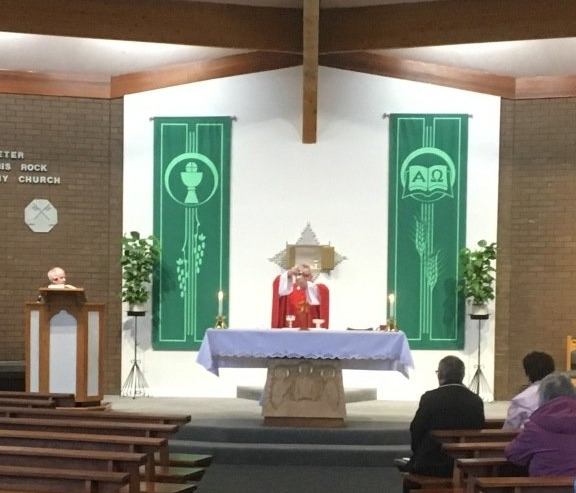
Prayer for Peace Programme
7am Church will open
8.15am Mass
9.30am-9.55am
Exposition of the Blessed Sacrament
9.40am The Rosary
10am Mass
10.30am-4pm
Exposition of the Blessed Sacrament
11am The Rosary
12noon Stations of the Cross
1pm Mass for Peace
2pm The Rosary
3pm The Chaplet of the Divine Mercy
4pm the Church will close.

Please pray for Our Sick : Margaret Callaghan Doreen Cleary, Neil Boyle, John Rielly, Molly Strang, James Clark, Fr. Michael McLaughlin, Patricia Henderson, Joanna Maier (Connecticut USA), Therese Gilgunn Tressy Callaghan, Suzanne McMurray, Marie White, Lesley Watson (Spain) John McGuire, Jill Brown, Maureen McHugh,Margaret Burke, Paul Kearney, Kathleen Daly, Karen Pritchatt, Louise Newton, Faith Lyndsey, Marie McGuire, James Morton, Thomas Daly, Andrew McCluskey, Margaret Loan, Premature Baby Vincent McDowell, Gudren Berk (Germany), Jaqueline McReynolds, Mary Morrison, Helen Howarth (Easterhouse), Avril McCluskey, Carol Corr, Margaret Park, Thomas Kennedy, Alana Hepburn, Michael Ritchie, Hugh O'Donnell, May Brandon, Michelle McDade and all our sick. .
24th October Mass of the Sick 10am Mass 7th November Annual Mass for the Dead 10am Mass
Will be available in the porch from this weekend. Mass will be offered each day in November for those names included on the list. You may include an offering alongside the list in your envelope. And from Tuesday there will be a box in the porch to return them.

Panto 2027 January 8th 2027 Goldilocks Price £36 including Bus Sign up Sheet in Porch Scan the QR code on the notice board in the Church Click on the following link as well. St Peters Panto Trip Jan 2027 – Fill in form
Saint John Paul II’s Story “Open wide the doors to Christ,” urged John Paul II during the homily at the Mass where he was installed as pope in 1978. Born in Wadowice, Poland, Karol Jozef Wojtyla had lost his mother, father, and older brother before his 21st birthday. Karol’s promising academic career at Krakow’s Jagiellonian University was cut short by the outbreak of World War II. While working in a quarry and a chemical factory, he enrolled in an “underground” seminary in Kraków. Ordained in 1946, he was immediately sent to Rome where he earned a doctorate in theology. Back in Poland, a short assignment as assistant pastor in a rural parish preceded his very fruitful chaplaincy for university students. Soon Fr. Wojtyla earned a doctorate in philosophy and began teaching that subject at Poland’s University of Lublin. Communist officials allowed Wojtyla to be appointed auxiliary bishop of Kraków in 1958, considering him a relatively harmless intellectual. They could not have been more wrong! Bishop Wojtyla attended all four sessions of Vatican II and contributed especially to its Pastoral Constitution on the Church in the Modern World. Appointed as archbishop of Kraków in 1964, he was named a cardinal three years later. Elected pope in October 1978, he took the name of his shortlived, immediate predecessor. Pope John Paul II was the first non-Italian pope in 455 years. In time, he made pastoral visits to 124 countries, including several with small Christian populations. John Paul II promoted ecumenical and interfaith initiatives, especially the 1986 Day of Prayer for World Peace in Assisi. He visited Rome’s main synagogue and the Western Wall in Jerusalem; he also established diplomatic relations between the Holy See and Israel. He improved Catholic-Muslim relations, and in 2001 visited a mosque in Damascus, Syria. The Great Jubilee of the Year 2000, a key event in John Paul’s ministry, was marked by special celebrations in Rome and elsewhere for Catholics and other Christians. Relations with the Orthodox Churches improved considerably during his papacy. “Christ is the center of the universe and of human history” was the opening line of John Paul II’s 1979 encyclical, Redeemer of the Human Race. In 1995, he described himself to the United Nations General Assembly as “a witness to hope.” His 1979 visit to Poland encouraged the growth of the Solidarity movement there and the collapse of communism in central and eastern Europe 10 years later. John Paul II began World Youth Day and traveled to several countries for those celebrations. He very much wanted to visit China and the Soviet Union, but the governments in those countries prevented that. One of the most well-remembered photos of John Paul II’s pontificate was his one-on-one conversation in 1983, with Mehmet Ali Agca, who had attempted to assassinate him two years earlier. In his 27 years of papal ministry, John Paul II wrote 14 encyclicals and five books, canonized 482 saints and beatified 1,338 people. In the last years of his life, he suffered from Parkinson’s disease and was forced to cut back on some of his activities. Pope Benedict XVI beatified John Paul II in 2011, and Pope Francis canonised him in 2014. Reflection Before John Paul II’s funeral Mass in St. Peter’s Square, hundreds of thousands of people had waited patiently for a brief moment to pray before his body, which lay in state inside St. Peter’s for several days. The media coverage of his funeral was unprecedented. Presiding at the funeral Mass, Cardinal Joseph Ratzinger—then dean of the College of Cardinals and later Pope Benedict XVI—concluded his homily by saying: “None of us can ever forget how, in that last Easter Sunday of his life, the Holy Father, marked by suffering, came once more to the window of the Apostolic Palace and one last time gave his blessing urbi et orbi (‘to the city and to the world’). “We can be sure that our beloved pope is standing today at the window of the Father’s house, that sees us and blesses us. Yes, bless us, Holy Father. We entrust your dear soul to the Mother of God, your Mother, who guided you each day and who will guide you now to the glory of her Son, our Lord Jesus Christ. Amen.”
First Reading Isaiah 45:1,4-6 The Lord chooses Cyrus to subdue the nations for the sake of Israel.. Responsorial Psalm Psalm 96:1,3-10 Sing praise to the Lord. Second Reading 1 Thessalonians 1:1-5b Paul greets the Thessalonians, recalling the Gospel they received. Gospel Reading Matthew 22:15-21 The Pharisees send their disciples to test Jesus with a question about taxes. Background on the Gospel Reading In today’s Gospel Jesus and the religious leaders in Jerusalem continue their tense exchange of questions and challenges. At this point the disciples of the Pharisees, together with the Herodians, try to entrap Jesus by their question about the payment of taxes. Matthew sets up an unusual partnership between the Pharisees and the Herodians. The Herodians were supporters of Herod Antipas, a Jewish political leader who collaborated with the Romans. Such collaboration would have required a compromised observance of the Mosaic Law. The Pharisees, on the other hand, taught scrupulous observance of the Mosaic Law and opposed Roman occupation. Herodians favored the payment of taxes; the Pharisees opposed it. The Herodians and the Pharisees approach Jesus, asking that he take sides in their dispute. If Jesus answers with the Pharisees, he shows himself to be an enemy of Rome. If he answers with the Herodians, he offends popular Jewish religious sensibilities. Jesus’ response to this attempt to trap him exposes the guile of his questioners. From his first words to them, Jesus shows that he is very much aware of what they are trying to do. He asks to see a Roman coin, which is readily provided to him. It may have come from the hand of a Herodian, but the Pharisees show themselves to be quite willing to accept this compromise. Jesus has already exposed the Pharisees as hypocrites. Jesus takes his response one step further. He asks that his questioners examine the coin. Agreeing that it is Caesar’s image on the coin, Jesus tells them that it must belong to Caesar. Avoiding the question of lawfulness altogether, Jesus answers their question with simple logic. Then, going further still, Jesus tells them that their obligation is to pay to God that which belongs to God. Jesus’ response to the Herodians and Pharisees suggests the ethic that Christians ought to adopt. It reminds us of the importance of keeping things in their proper perspective. Do we attach ourselves to worldly things at the expense of the love and honor that we owe to God?
Coffee Morning Every Tuesday. Next one 20th October

Our Recently Dead Paul Ward, Marie Lavety, Paul Gillen Month Minds & Anniversaries Jean McCann, Jane Hayes, Margaret Higgins, Debbie McMahon, Peter Doyle, Agnes Gallacher, Ann & Hugh Rodgers, Martin McPolland, Giuseppe De Marco, Pat Dougan, Catherine Dickson Please if you could make sure all month minds and anniversaries are handed in no later than Wednesday Night. If they come in after that they will be read out at Mass on Sunday. If the recently dead come in after the Wednesday deadline they too will be read out at Mass on the Sunday
5th December If anyone's workplace donate gifts for kids at Chrismas please keep St. Peter's Church in mind as we are organising Breakfast with Santa for over 100 children in the area free of charge and any support would be greatly appreciated.... also tombola gifts and selection boxes ... .give Anne Frances a message or hand in to the church.
Week Day Mass from 7th October will be held in the side Chapel, Except for Funerals and when the children come to Mass.