800th Anniversary of the Death of St. Francis
Webmaster • September 25, 2026
From Friday 25th September to Sunday 4th October. St. Francis' Peace Prayer will be said at the end of every Mass.
Monday 28th September
A Parish Mass for St. Peter's in St. John Olgivie Church7pm. Veneration of Relic of St. Francis' at the End of the Mass. I will celebrate the Mass. Bus will be available to take you to St. John Olgivie's if you do not have transport. List at back of the Church.
Sunday 4th October
Feast of St. Francis of Assisi Blessing of Pets After 11am Mass
Week Day Mass from 7th October will be held in the side Chapel, Except for Funerals and when the children come to Mass.

Please pray for Our Sick : Margaret Callaghan Doreen Cleary, Neil Boyle, John Rielly, Molly Strang, James Clark, Fr. Michael McLaughlin, Patricia Henderson, Joanna Maier (Connecticut USA), Therese Gilgunn Tressy Callaghan, Suzanne McMurray, Marie White, Lesley Watson (Spain) John McGuire, Jill Brown, Maureen McHugh,Margaret Burke, Paul Kearney, Kathleen Daly, Karen Pritchatt, Louise Newton, Faith Lyndsey, Marie McGuire, James Morton, Thomas Daly, Andrew McCluskey, Margaret Loan, Premature Baby Vincent McDowell, Gudren Berk (Germany), Jaqueline McReynolds, Mary Morrison, Helen Howarth (Easterhouse), Avril McCluskey, Carol Corr, Margaret Park, Thomas Kennedy, Alana Hepburn, Michael Ritchie, Hugh O'Donnell, May Brandon, and all our sick. .

Our Recently Dead David Cunningham, Vera McKale, Colin John Lehan, Diane Gray, James McAnaw, Marie Lavety Month Minds & Anniversaries John Corns, Margaret Barton, Cathie McFadden, David Cunningham (Anniversary 8th October), Jimmy Hughes, Betty Hughes, Anne Cunningham, The Hughes, McGinn, Cunningham & Daly Families Please if you could make sure all month minds and anniversaries are handed in no later than Wednesday Night. If they come in after that they will be read out at Mass on Sunday. If the recently dead come in after the Wednesday deadline they too will be read out at Mass on the Sunday
24th October Mass of the Sick 10am Mass 7th November Annual Mass for the Dead 10am Mass
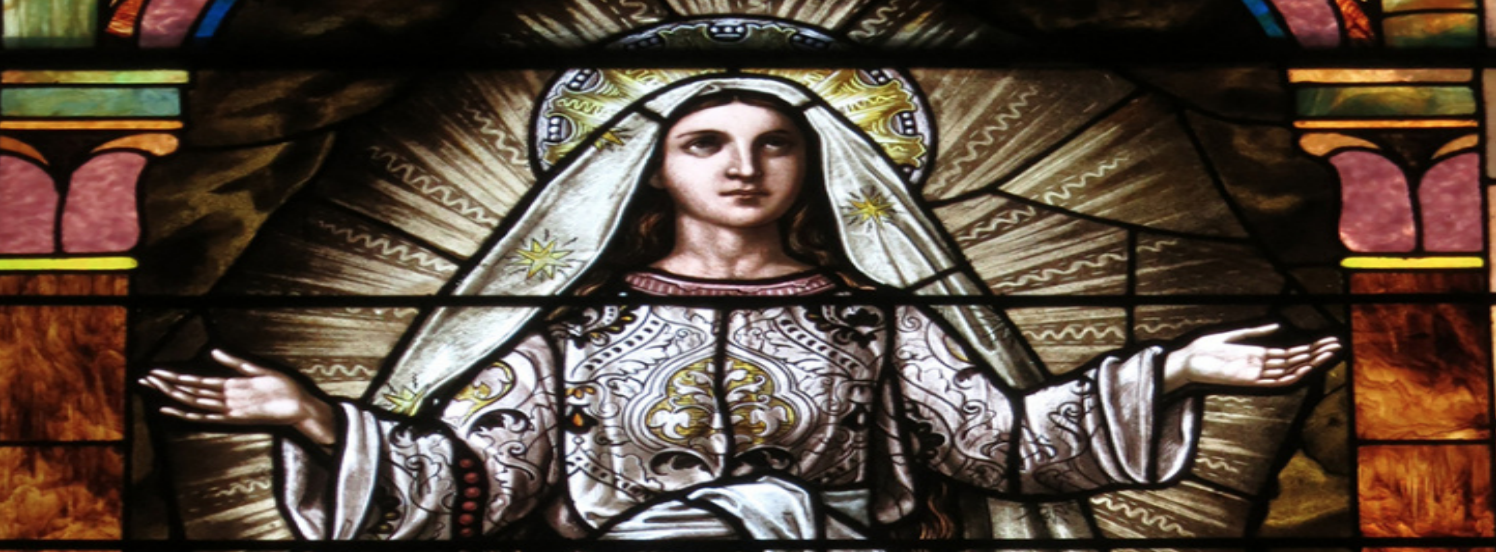
The Story of Our Lady of the Rosary Saint Pius V established the feast of Our Lady of Victory to thank God for the Christian defeat of the Turks at Lepanto—a victory attributed to praying the rosary . Pope Gregory XIII changed the name to Feast of the Holy Rosary–originally celebrated on the first Sunday in October–in 1573. Pope Clement XI extended the feast to the universal Church in 1716. And in 1913, Saint Pius X set the date for the feast that we know today of October 7. The development of the rosary has a long history. First a practice developed of praying 150 Our Fathers in imitation of the 150 Psalms. Then there was a parallel practice of praying 150 Hail Marys. Soon a mystery of Jesus’ life was attached to each Hail Mary. Though Mary’s giving of the rosary to Saint Dominic is recognized as a legend, the development of this prayer form owes much to the followers of Saint Dominic. One of them, Alan de la Roche, was known as “the apostle of the rosary.” He founded the first Confraternity of the Rosary in the 15th century. In the 16th century, the rosary was developed to consist of 15 mysteries: joyful, sorrowful and glorious. In 2002, Pope John Paul II added the five Mysteries of Light to this devotion. Reflection The purpose of the rosary is to help us meditate on the great mysteries of our salvation. Pius XII called it a compendium of the gospel. The main focus is on Jesus—his birth, life, death, and resurrection. The “Our Fathers” remind us that Jesus’ Father is the initiator of salvation. The “Hail Marys” remind us to join with Mary in contemplating these mysteries. They also make us aware that Mary was and is intimately joined with her Son in all the mysteries of his earthly and heavenly existence. The “Glory Bes” remind us that the purpose of all life is the glory of the Trinity. The rosary appeals to many. It is simple. The constant repetition of words helps create an atmosphere in which to contemplate the mysteries of God. We sense that Jesus and Mary are with us in the joys and sorrows of life. We grow in hope that God will bring us to share in the glory of Jesus and Mary forever.

Donated your spare winter coats or anoraks to The Rotary Club of Hamilton, helping us to support many local charities and community organisations which care for people who are homeless, escaping domestic violence, living in poverty, refugees. No money donations thanks, just drop off your coat(s) in the box whilst at Church Donate a coat during the month of October & sincere thanks
First Reading Ezekiel 18:25-28 It is possible to turn from sin and preserve one’s life. Responsorial Psalm Psalm 25:4-9 A prayer to God for mercy. Second Reading Philippians 2:1-11 (shorter form Philippians 2:1-5) Be like Christ who humbled himself and was exalted by God. Gospel Reading Matthew 21:28-32 Jesus poses a question to the chief priests and elders on the meaning of obedience. Background on the Gospel Reading The context for today’s Gospel is the mounting tension between Jesus and the Jewish religious leaders. Jesus has entered Jerusalem and overturned the money changers’ tables in the Temple. Jesus has caught the attention of the religious authorities; the chief priests and elders question Jesus about the source of his authority. Jesus refuses to name for these religious leaders the source of his authority. Instead, he questions the priests and elders through the parable we hear in today’s Gospel. The answer given by the religious leaders is correct, but it convicts them for their failure to heed the call of John the Baptist and for their inability to recognize the Kingdom of God. The situation Jesus poses is rather straightforward. Given the same task by their father, one son asserts his disobedience in words, but then obeys in his actions; the second son obeys with his words, but disobeys in his actions. The question that Jesus poses is pointed and direct: Which son did what the father wanted? All would agree that “actions speak louder than words” and that even if his words were disobedient, the son who did the work as ordered did the father’s will. Jesus’ conclusion is also direct. The chief priests and elders, the ones who speak most often about God, did not act accordingly. They did not respond to the message of repentance announced by John the Baptist with a change of heart. Instead, John’s message was heeded by those one would not expect to repent—tax collectors, prostitutes, and other sinners. Because of their actions, these sinners will enter the Kingdom of God ahead of the religious leaders. Jesus could ask us the same question. Do our words indicate our obedience to God? If not our words, do our actions? God desires a full conversion of heart, that our actions (and our words as well) will give evidence of our love for God.
A New Holy Water Font: has been donated to the parish by a parishioner, to be placed at the emergency exit going into the back car park. The plaque underneath will read: In Loving Memory Of all babies, Miscarried, stillborn or taken too soon. The font will be put up today the plaque will be put up at a later date. I want to say thank you to the parishioners who donated it.
The patron saint of Italy, Saint Francis of Assisi was a poor little man who astounded and inspired the Church by taking the gospel literally—not in a narrow fundamentalist sense, but by actually following all that Jesus said and did, joyfully, without limit, and without a sense of self-importance. Serious illness brought the young Saint Francis to see the emptiness of his frolicking life as leader of Assisi’s youth. Prayer—lengthy and difficult—led him to a self-emptying like that of Christ, climaxed by embracing a leper he met on the road. It symbolized his complete obedience to what he had heard in prayer: “Francis! Everything you have loved and desired in the flesh it is your duty to despise and hate, if you wish to know my will. And when you have begun this, all that now seems sweet and lovely to you will become intolerable and bitter, but all that you used to avoid will turn itself to great sweetness and exceeding joy.” From the cross in the neglected field-chapel of San Damiano, Christ told him, “Francis, go out and build up my house, for it is nearly falling down.” Francis became the totally poor and humble workman. He must have suspected a deeper meaning to “build up my house.” But he would have been content to be for the rest of his life the poor “nothing” man actually putting brick on brick in abandoned chapels. He gave up all his possessions, piling even his clothes before his earthly father—who was demanding restitution for Francis’ “gifts” to the poor—so that he would be totally free to say, “Our Father in heaven.” Saint Francis was, for a time, considered to be a religious fanatic, begging from door to door when he could not get money for his work, evoking sadness or disgust to the hearts of his former friends, ridicule from the unthinking. But genuineness will tell. A few people began to realize that this man was actually trying to be Christian. He really believed what Jesus said: “Announce the kingdom! Possess no gold or silver or copper in your purses, no traveling bag, no sandals, no staff” (Luke 9:1-3). Saint Francis of Assisi’s first rule for his followers was a collection of texts from the Gospels. He had no intention of founding an order, but once it began he protected it and accepted all the legal structures needed to support it. His devotion and loyalty to the Church were absolute and highly exemplary at a time when various movements of reform tended to break the Church’s unity. Saint Francis of Assisi was torn between a life devoted entirely to prayer and a life of active preaching of the Good News. He decided in favor of the latter, but always returned to solitude when he could. He wanted to be a missionary in Syria or in Africa, but was prevented by shipwreck and illness in both cases. He did try to convert Sultan Malik alKamil during the Fifth Crusade. During the last years of his relatively short life, he died at 44, Francis was half blind and seriously ill. Two years before his death he received the stigmata, the real and painful wounds of Christ in his hands, feet and side. On his deathbed, Saint Francis of Assisi said over and over again the last addition to his Canticle of the Sun, “Be praised, O Lord, for our Sister Death.” He sang Psalm 141, and at the end asked his superior’s permission to have his clothes removed when the last hour came in order that he could expire lying naked on the earth, in imitation of his Lord. Reflection Saint Francis of Assisi was poor only that he might be Christ-like. He recognized creation as another manifestation of the beauty of God. In 1979, he was named patron of ecology. He did great penance—apologizing to “Brother Body” later in life—that he might be totally disciplined for the will of God. Francis’ poverty had a sister, Humility, by which he meant total dependence on the good God. But all this was, as it were, preliminary to the heart of his spirituality: living the gospel life, summed up in the charity of Jesus and perfectly expressed in the Eucharist. He is the Patron Saint of: Animals, Archaeologists, Ecology, Italy, Merchants, Messengers, Metal Workers
Coffee Morning Every Tuesday starting from 29th September in the Side Chapel after the 10am Mass.